

A deduction game for science
Students compare five look-alike animals, read real field data and rule out the ones the evidence excludes. Free, in a browser, no student accounts; about 5–10 minutes a round.
Play a round yourself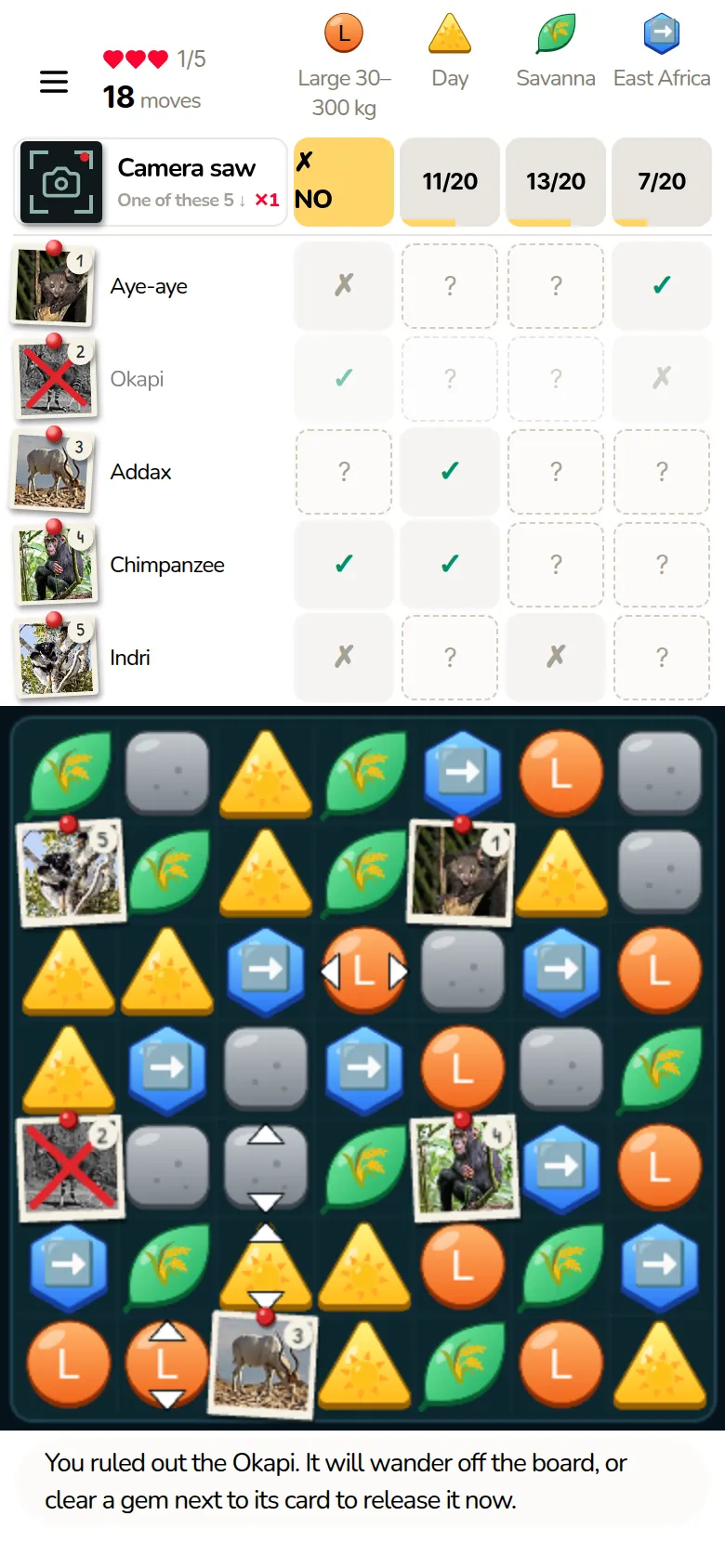
What students do in a round
- Five look-alike animals sit on the board. One of them is the one the camera saw.
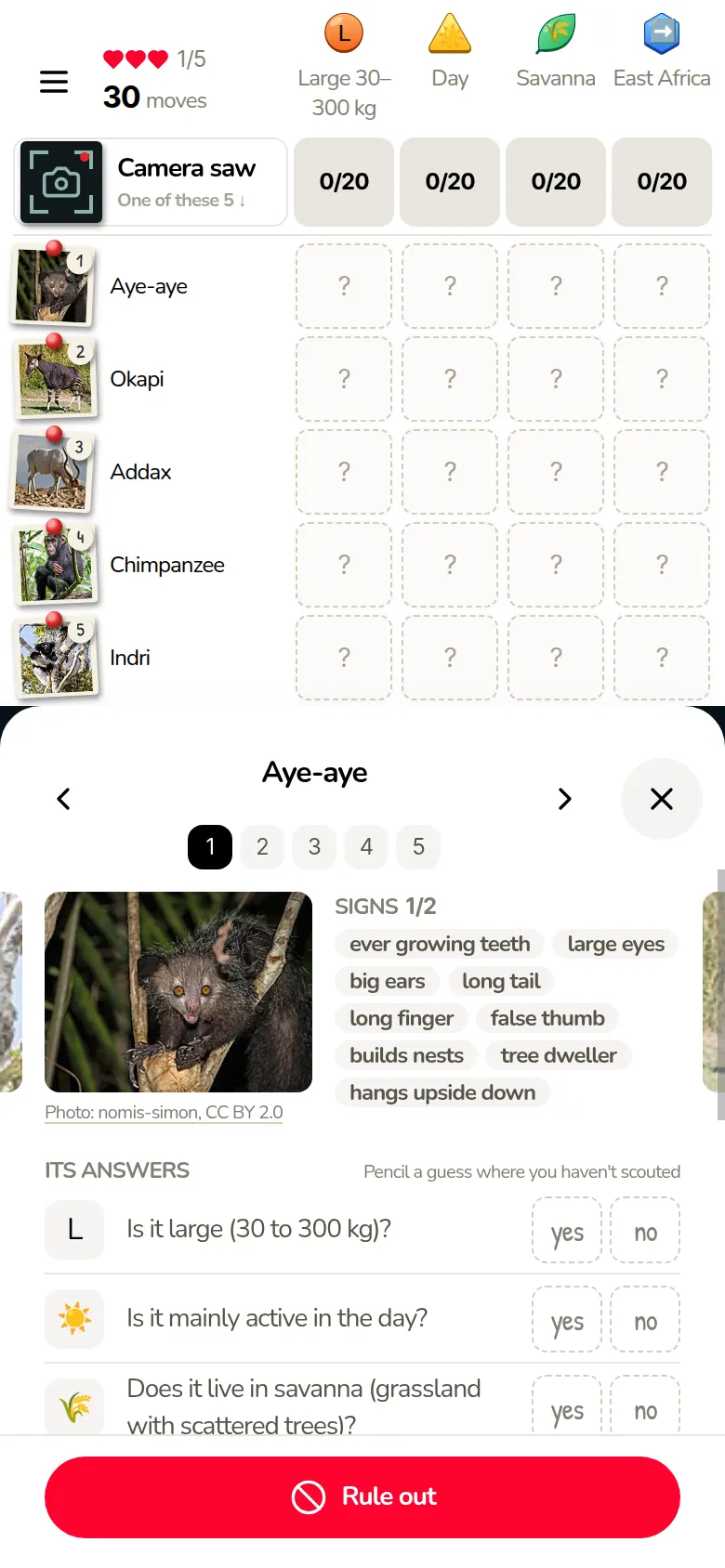
- They have 30 moves. Four yes-or-no questions ask about the camera's animal; matching 20 of a question's gems answers it.
- Clearing a question's gems next to an animal's card scouts that animal's own answer.
- The answers never rule anyone out by themselves. Students compare them with each animal's field guide and rule out the ones that can't be it, then clear gems next to them to release them.
- Rule out the one the camera saw by mistake, and it escapes: the round is lost and costs a heart. A trail is 5 rounds with 3 hearts.
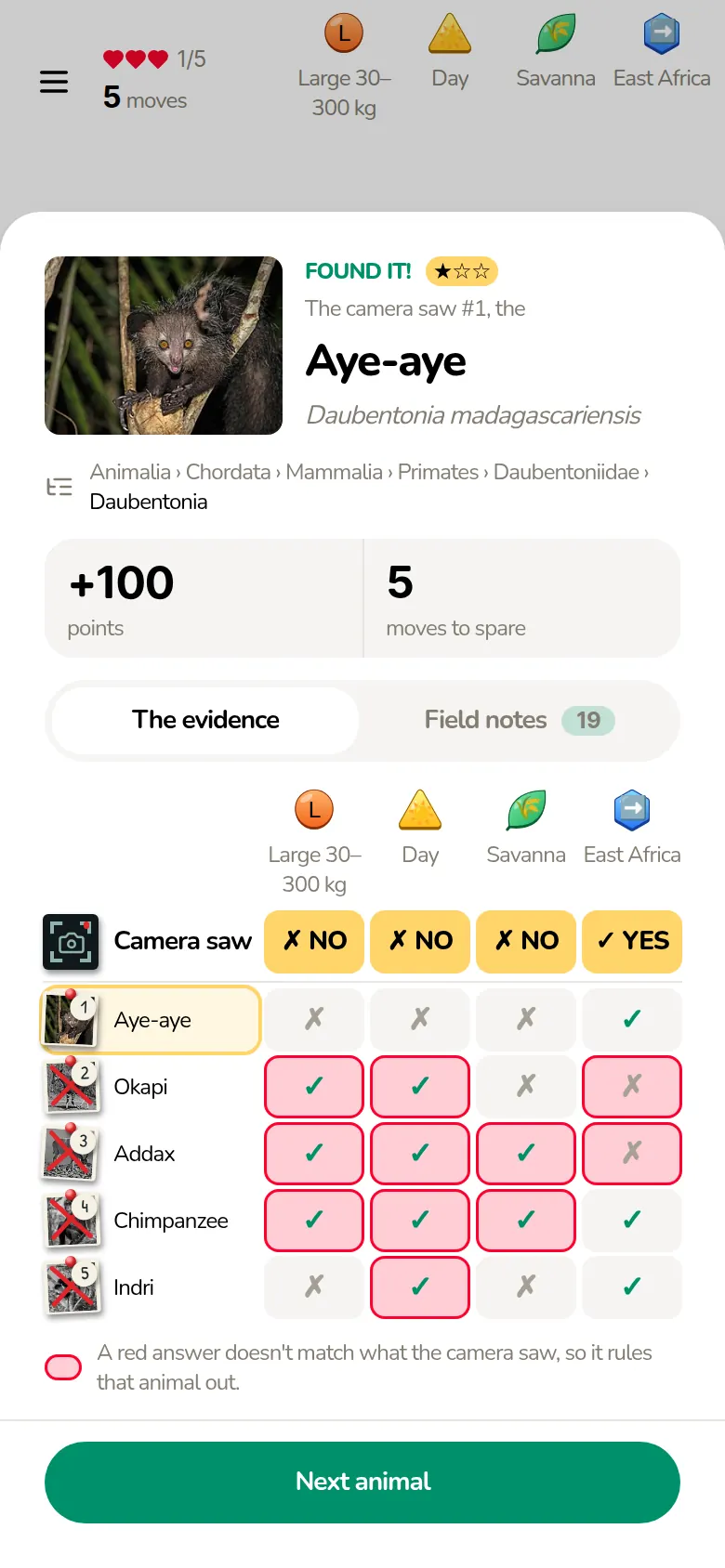
- The round-end card shows the full record: the family tree, the range map and the sources.
What they practice
- Elimination: ruling out each animal that several pieces of evidence together exclude.
- Reading a data table: the five animals' answers to four questions.
- Precise wording: “mostly” isn't “only”, and “no record” isn't “no”.
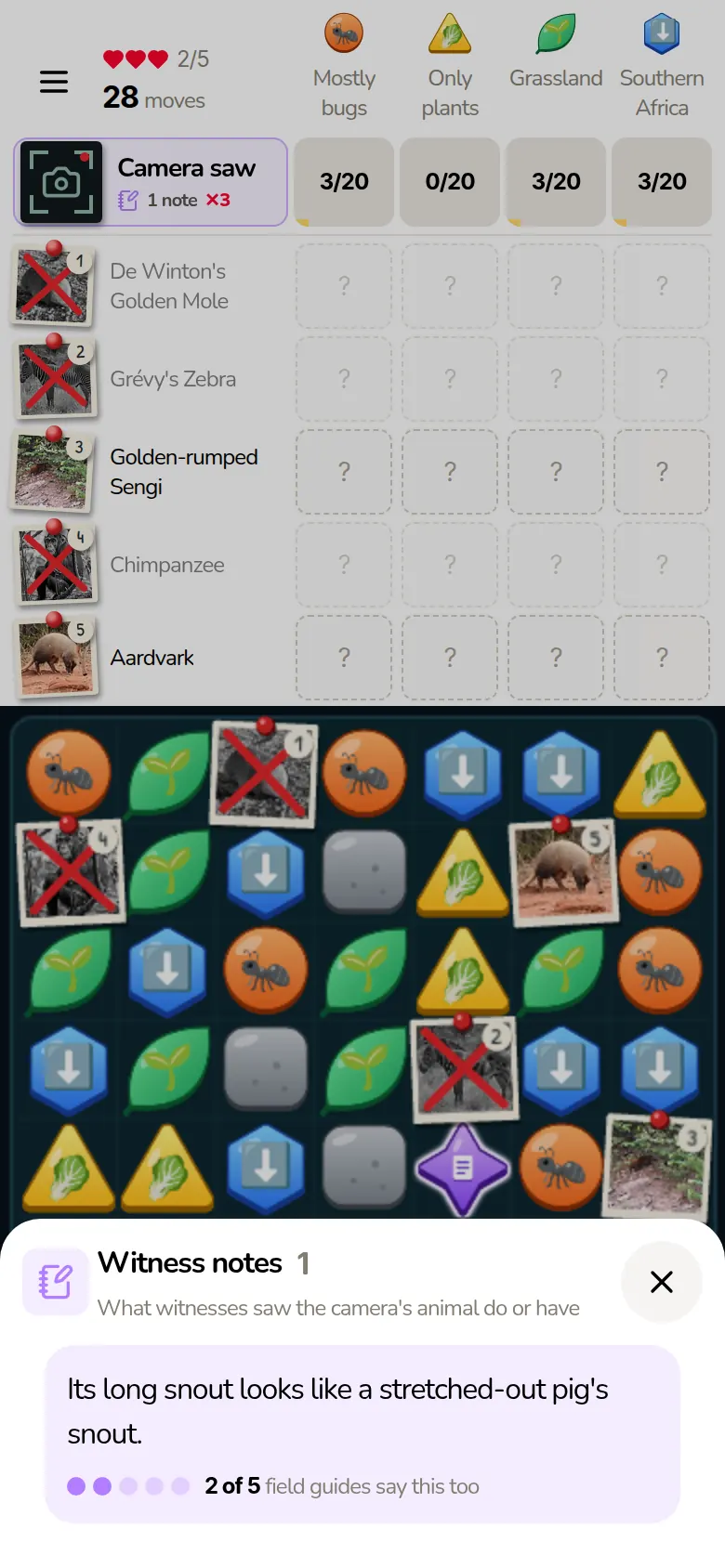
- Evidence from text: matching a witness note to the animals' field guides.
- Comparing close relatives: rounds are built from look-alikes, like the okapi and the hirola.
- Geography and taxonomy: questions about regions within a continent, and a family tree on every round-end card.
These map onto NGSS practices (analyzing and interpreting data, engaging in argument from evidence) and ideas like MS-LS4-2.
The game does not claim to teach these on its own; it gives repeated, low-stakes practice with real data.
So far tested with simulated players, not yet in a classroom study: one who matches without reasoning finds nothing, and a careful one finds the animal in over 90% of rounds.
Using it with a class
- Think aloud in pairs. One student plays; the other has to agree to every rule-out.
- Debrief losses. After an escape, ask which answer or note was misread. The round-end card has everything needed.
- Share a seed. A class link gives everyone the same animals, so the class can compare strategies.
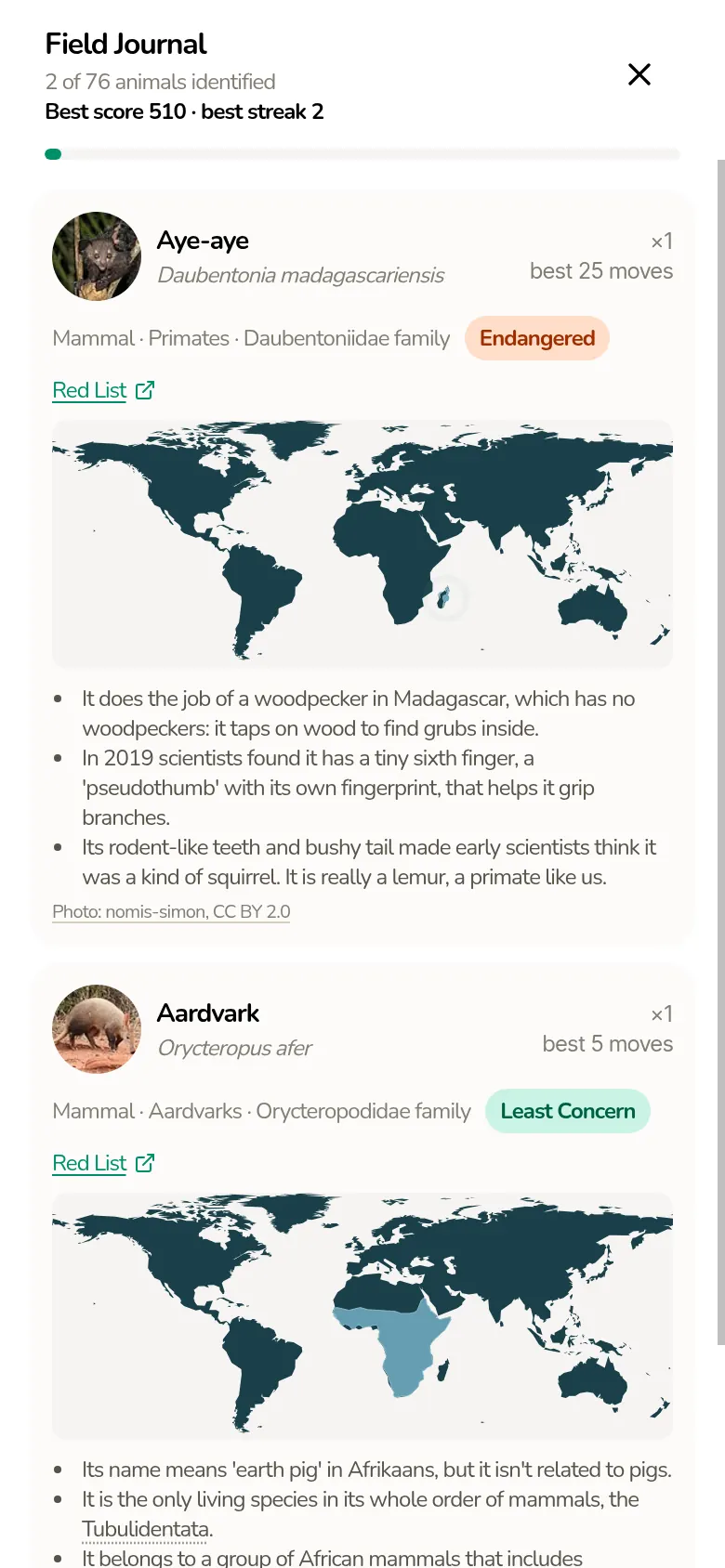
- Extend from the journal. Students pick an animal they found and research a trait the game simplified.
Sound starts off, and the board plays with a keyboard too.
Make a class link
Everyone who opens it starts with the same animals. Each visit to this page makes a new one.
Student privacy
Without signing in
- The game plays fully without an account.
- No name or email is asked for.
- The Field Journal stays in the browser.
- Finished rounds are saved with no link to the player.
With signing in
- Signing in is optional. Players under 13 should ask a parent or guardian first.
- Sign-in is handled by Clerk, which keeps the email address.
- The game keeps the player's results, to sync their Field Journal between devices.
- A parent can ask for a child's account and results to be deleted.
Either way: no ads, no tracking cookies, no analytics. Animal photos load from Wikimedia Commons. The privacy policy has the details.
Where the facts come from
All 76 animals' facts come from ranked sources: the IUCN Red List and its range maps first, then scientific databases like Animal Diversity Web and AmphibiaWeb, then zoos and wildlife agencies. Every source is on the round-end card.
Its limits
- Traits are simplified into categories, like a diet of plants, meat, insects or a mix. Real animals vary.
- “No record” doesn't mean “no”: an animal may share a trait its record doesn't mention.
- Pictures simplify: an ant stands for “eats mostly bugs”. The exact wording is in the text.
- Teachers can't see students' reasoning yet.
Coming later: not available yet
- Not available yet: a printable teacher guide with a round walkthrough and debrief activities.
- Not available yet: a standards map showing which NGSS practices each activity maps onto.
- Not available yet: class results from a class link, per animal, with no student names.
Questions teachers ask
Is it free?
Yes. No ads, and nothing to install.
Do students need accounts?
No. The game plays fully without one. Signing in is optional; it keeps a player's Field Journal on more than one device.
What grades is it for?
Grades 6–12.
How long is a round?
About 5–10 minutes.
What devices does it run on?
Phones and computers, in a browser.
Can the whole class get the same animals?
Yes. Share a class link from this page: everyone who opens it gets the same animals and the same boards.
Can I see my students' results?
Not yet. Class results are on the list under Coming later.
Is the information accurate?
Every fact comes from a ranked source, the IUCN Red List first, and each round-end card lists its sources. Traits are simplified into categories, and "no record" doesn't mean "no".
Does it work offline?
No. It needs an internet connection.